Flaring Emissions Increased in 2023
October 17, 2024
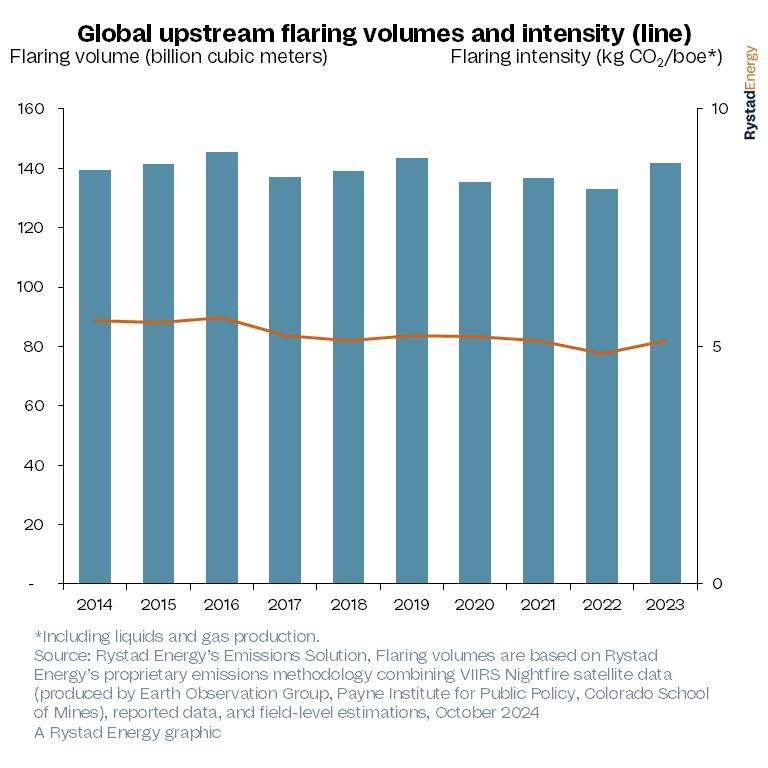
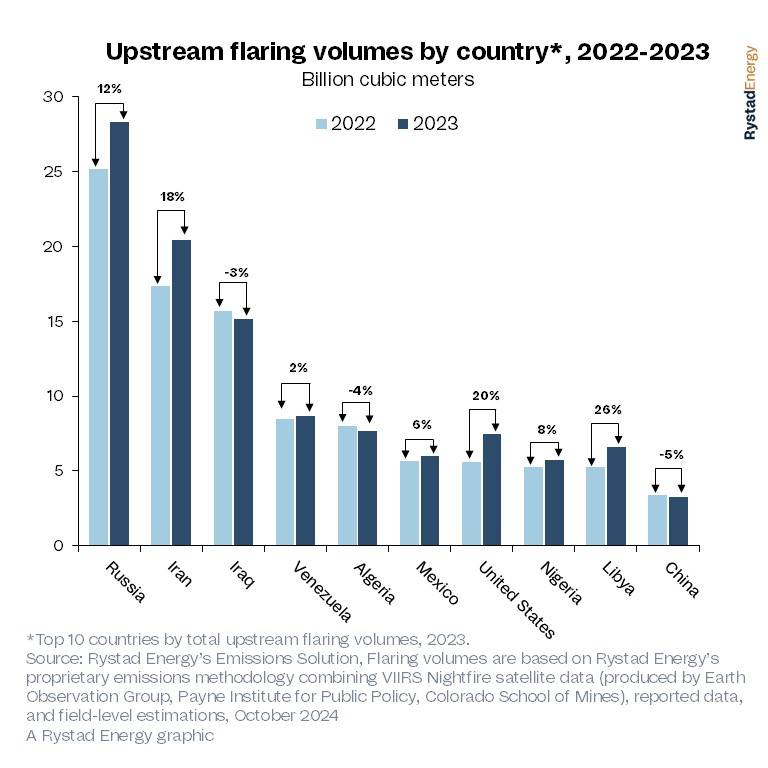
Flaring emissions from global upstream oil and gas production activity increased by 7% from 2022 to 2023, according to latest Rystad Energy research.
Upstream activities emit about 1 gigatonne per year of CO2 in total, with flaring contributing around 30% of those emissions in 2023 assuming 98% flaring efficiency on average.
Flaring reduction is considered a low-hanging fruit for oil and gas companies trying to reduce their carbon footprint. However, this recent uptick underscores the challenges facing the industry, particularly in key producing countries such as Russia, Iran and Iraq.
Rystad Energy’s analysis leverages satellite data in combination with global inventory overviews to assess flaring practices globally, revealing that the Middle East, Africa and Russia collectively made up about 70% of total flaring volumes in 2023. The Middle East, in particular, saw a sharp increase in its flaring levels, reaching approximately 45 billion cubic meters (Bcm) — a 7% rise from last year.
Russia continues to dominate on a country level, with around 28 Bcm flared in 2023 — up 12% from last year. Other countries with the highest absolute increases were Iran, the US and Libya, all of which had greater than 10% increases. The significant uptick in the US can be attributed to challenges related to midstream gas takeaway capacity, especially in the Permian Basin.
Flaring intensity, measured as kilograms of CO2 per barrel of oil equivalent (kg CO2/boe), shows emissions relative to production volumes and provides insights into how effectively regions and countries are managing their flaring practices. The US and China, despite being among the top 10 largest emitters in absolute terms, have flaring intensities of less than 3 kg CO2/boe, significantly below the global average of 5 kg CO2 per barrel of oil equivalent. Conversely, Venezuela has one of the highest flaring intensities, emitting almost 40 kg CO2/boe.
The global upstream oil and gas industry has flared about 140 Bcm of gas annually in the last decade, resulting in a substantial waste of valuable resources and contributing significantly to greenhouse gas emissions in the upstream oil and gas industry, says Rystad.