Jan De Nul Launches Second Giant Cable Laying Vessel
April 7, 2026
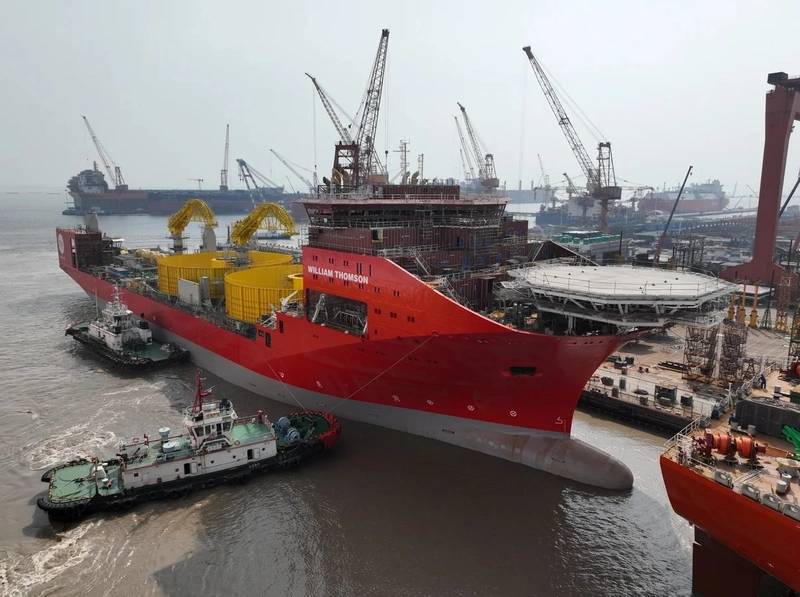
Belgian marine contractor Jan De Nul has launched its second next-generation cable laying vessel (CLV), William Thomson, as it expands capacity to support growing offshore wind and grid interconnection projects.
The William Thomson vessel follows the earlier launch of its sister ship Fleeming Jenkin in October 2025, with both units set to become the largest cable-laying vessels of their kind.
Both vessels, launched at CMHI Haimen shipyard in China, measure 215 meters in length and has a cable-carrying capacity of 28,000 tonnes, allowing longer subsea cables to be installed in a single campaign and reducing the need for return trips.
The vessels are designed to operate in water depths of up to 4,000 meters and are equipped with systems capable of handling cable tensions of up to 150 tonnes. They feature three cable carousels and can lay up to four cables simultaneously.
Jan De Nul said both vessels were designed in-house, combining its experience in subsea cable installation with new engineering capabilities.
“The William Thomson and its identical sister, the Fleeming Jenkin, bring together all the expertise in cable installation that we have built up over the past fifteen years. They are the highest-performing and most efficient cable-laying vessels on the market,” said Wouter Vermeersch, Director Subsea Cables Offshore Energy at Jan De Nul.
The Fleeming Jenkin is scheduled for delivery in the fourth quarter of 2026, while William Thomson is expected to become operational in the first half of 2027.
Once in service, both vessels will be deployed on their first assignment under the 2GW offshore grid program led by TenneT in the Netherlands and Germany.
The program involves installing more than 2,800 kilometers of 525 kV direct current subsea cables across four grid connections, each capable of transmitting up to 2 GW of power.
Jan De Nul said one of the vessels will also support future projects, including cable installation for Belgium’s Princess Elisabeth Island energy hub, which is being developed to connect offshore wind farms and strengthen interconnections between North Sea countries.
The new vessels incorporate hybrid power systems with a 2.5 MWh battery and engines capable of running on biofuel and green methanol, alongside emission-reduction technology designed to meet strict European standards.
The company is also expanding its subsea fleet with additional vessels for cable protection, including trenching support and rock installation units, as it positions for increased demand in offshore renewable infrastructure.