More to Consider than CO2 in CCS Leakage Risks
Wendy Laursen
January 29, 2026
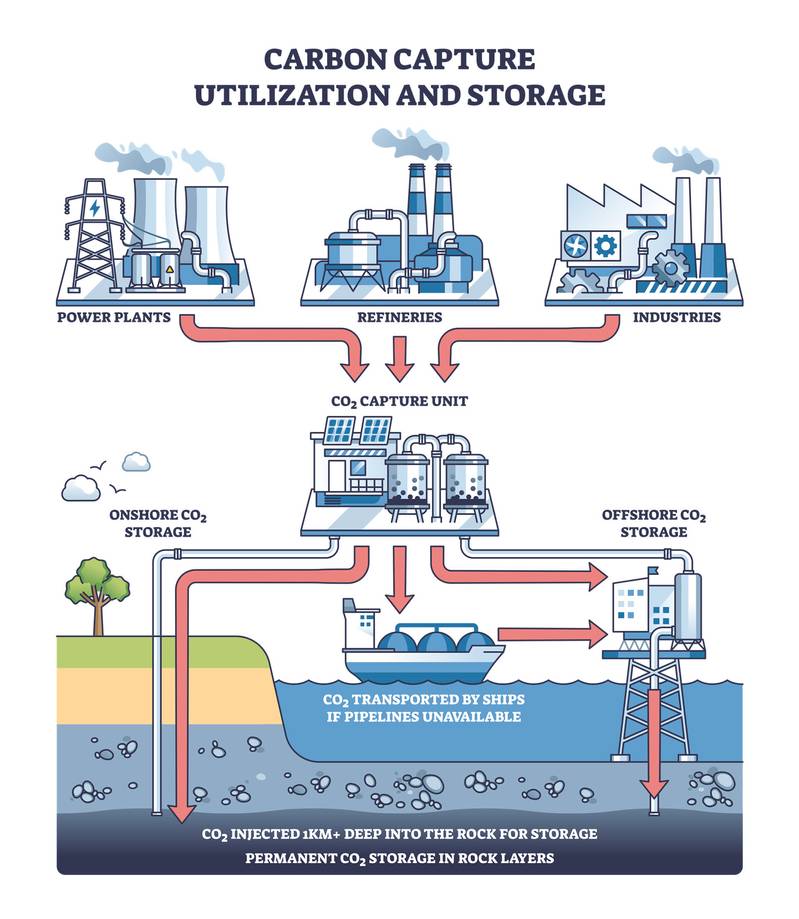
Researchers from the Technical University of Denmark have highlighted that taking a comprehensive view of the chemical composition of potential fluids leaking from geological CO2 storage reservoirs raises new questions about the potential risks.
The study, published in the Journal of Environmental Management, says, albeit small, the risk of failures during operations and storage does exist.
Different environmental modelling studies have suggested that different annual leakage rates (0.001%–0.01% of stored CO2) are acceptable for the climate mitigation benefits of carbon capture and storage (CCS).
“Despite measures to ensure containment, there is a risk of CO2 leakage,” they say. “Other than the environmental impacts of pure CO2, it is essential to understand the full composition of the fluids reaching shallow and surface environments.”
Impurities can come from several sources:
The captured CO2 may contain impurities that are directly toxic for living organisms (e.g. CO, H2S, SOx, and NOx).
Chemicals such as hydrocarbons or previously injected biocides and surfactants in depleted hydrocarbon fields may accompany the CO2 leaking from a reservoir.
CO2 and some impurities alter the pH when dissolved in water and trigger geochemical reactions, mobilizing or immobilizing harmful chemicals (e.g. trace metals) in the leaking brine.
Microbial activity in storage reservoirs or along the leakage pathways may produce or consume potentially harmful chemicals (e.g. H2S and CH4).
The researchers point to under-explored consequences such as the potential of well cement to release trace elements under acidified conditions, the combined toxic impacts of different chemicals, the capacity of overburden in neutralization of the leakage, and the lack of field experiments that use realistic compositions of leaking fluids instead of pure CO2.
Among the researchers’ main findings is that more research is required:
• CO2 release experiments in seabed sediments have been performed, but they need to be repeated using a more realistic composition of potentially leaking fluids.
• The coupled ecological impacts of the leaking chemicals may be more significant than the individual impacts. For example, a drop in pH due to the heightened CO2 levels drives H2S speciation toward the more toxic H2S concentration. Fundamental research on such interplays as well as toxicity tests using realistic chemical compositions is required.
“Future modelling and experimental efforts must consider the full composition of potential leakage events for realistic environmental risk assessments.”
CCS has made the news in January:
Inpex to Refile Environmental Plan for Australia’s Offshore CCS Project
TotalEnergies, Mitsui, Nordsøfonden Get CO2 Storage Permit in North Sea