TECH FILE: Spray-Based Immersion Cooling to Boost Battery Safety
July 14, 2026
The Korea Institute of Machinery and Materials (KIMM) has unveiled what it says is the world's first spray-based immersion cooling technology for lithium-ion battery packs, a development that could improve thermal management and fire safety while dramatically reducing the amount of dielectric coolant required.
Developed by a research team led by Dr. Jinsub Kim at KIMM's Heat Pump Research Center, the system combines two cooling approaches: dielectric liquid is sprayed directly onto the tops of battery cells while the bottom portion of the pack remains partially immersed in the same non-conductive fluid. The hybrid approach enables direct heat removal through liquid contact while forced convection from the partially immersed section enhances overall cooling performance.
In testing with an actual lithium-ion battery pack operating at a 4C charge-discharge rate—representative of aggressive fast-charging conditions—the technology maintained cell temperatures below 35°C, a critical threshold for minimizing thermal degradation and reducing the risk of thermal runaway.
The most notable engineering achievement may be efficiency. Conventional immersion cooling systems require battery packs to be completely submerged, adding significant weight, cost and coolant volume. KIMM's approach reportedly reduces dielectric-liquid consumption by approximately 85%, using just 10-20% of the coolant required by traditional immersion cooling while maintaining comparable—or better—thermal performance.
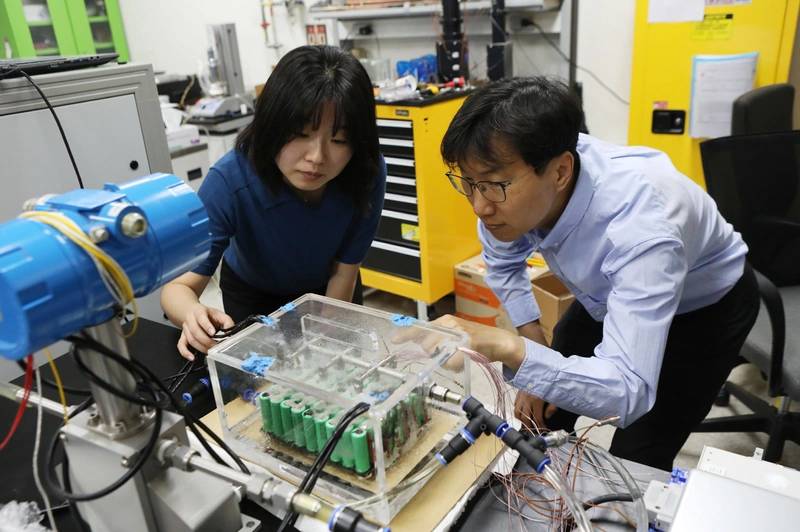
 The spray-based immersion cooling chamber. Image Copyright KIMM
The reduction has important implications for transportation applications where weight is critical, particularly electric vehicles, marine battery systems and high-power commercial vessels pursuing rapid charging between operations. Lower coolant volumes also reduce system cost and simplify packaging.
Beyond mobility, the technology could prove valuable for stationary energy storage systems and data centers, where lithium-ion battery safety has become an increasing concern. Because the dielectric liquid is non-flammable, it not only cools the cells but may also help suppress fire propagation should a thermal event occur.
Unlike conventional air- or liquid-cooled battery systems that rely on heat sinks or cold plates to indirectly remove heat, spray-based immersion cooling places the coolant in direct contact with the battery cells, significantly improving heat transfer during high-power operation.
Looking ahead, the KIMM researchers plan to use artificial intelligence to identify new dielectric fluids with optimized thermophysical properties that further enhance cooling performance.
The research was conducted under South Korea's Ministry of Climate, Energy and Environment's Core Technology Development Project for Energy Demand Management and was published in Applied Thermal Engineering (Vol. 282, 2026).
For the maritime industry, where battery-powered ferries, offshore vessels, harbor craft and hybrid propulsion systems continue to grow in both size and charging power, technologies that simultaneously improve thermal management, reduce system weight and mitigate fire risk could become an increasingly important element of next-generation battery architecture.