Dutch Engineering Firms Present Floating Offshore Substation Concept
October 11, 2024
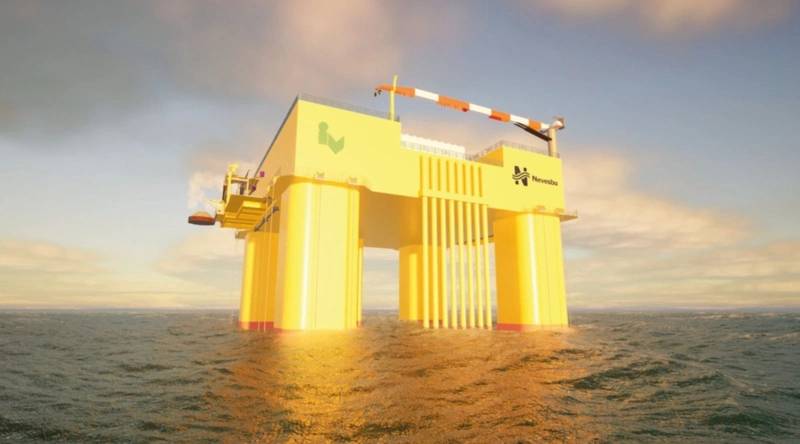
Nevesbu, together with Iv, has developed a patented concept for a floating offshore substation (FOSS), which has already been tested at model scale at the Maritime Research Institute Netherlands (MARIN) in the Netherlands.
The concept developed by Iv and Nevesbu is based on proven Tension Leg Platform (TLP) technology.
The FOSS has been designed to convert 1.4 GW to 2 GW of power, with a DC export link of 300 to 525 kV.
Nevesbu tested the floating concept on scale model with different configurations of the cable guiding system (CGS). The model test was conducted within MARIN's SME slot.
The maximum wave height tested in the model basin corresponds to the once-in-100-years event west of Shetland, corresponding to significant wave heights of above 17 meters. An initial high-level verification showed that the measured maximum displacement, accelerations and CGS loads in irregular waves are similar to the results of Nevesbu's numerical model.
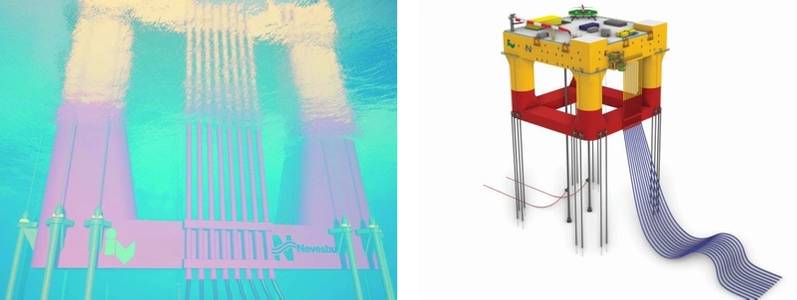 The look of the floating offshore substation above and under water (Credit: Nevesbu)
Nevesbu and Iv have investigated and compared several floating substation concepts in recent years.
Different floater types were investigated, like SPARs, buoys, semi-submersibles and tension leg platforms.
Each concept must adhere to the established requirements for offshore wind energy, avoiding excessive steel weight and maintaining simplicity in terms of fabrication.
Furthermore, it is essential to ensure safety and reliability, while also guaranteeing very high availability and a platform lifespan of no less than 30 to 40 years. In addition, the social costs of supplying sustainable electricity must remain affordable, and the solution itself should therefore not be too expensive in terms of costs.
Based on these principles and requirements, a selection was made for the most promising floater type.
According to Nevesbu, the floating HVDC platform has a deck area of 85 by 85 metres and raises approximately 25 metres above the water’s surface. The overall arrangement has been optimized for application on a floating substructure.
When the platform is installed at sea, it will be held in position with the help of so-called ‘tendons’ that are vertically anchored to the seabed, which restricts the vertical motions and accelerations.
Dynamic inter-array cables are being developed and tested at full scale already in the floating wind turbine pilots around the world and are therefore considered to have matured before deployment of the first FOSS units.
The DC export cables, on the other hand, are even more fatigue sensitive, due to the large core and surrounding metallic sheath. A cable guide system that solves the fatigue problem for the DC export cable(CGS) has also been developed by Nevesbu.
“The main challenge at the moment is that the dynamic conditions, as encountered by a FOSS, are uncharted territories for equipment and cable manufacturers (OEMs). The high-voltage equipment, as existing today, has not been designed for continuous motions and accelerations as will be experienced on a floating platform,” Nevesbu said.